

As we are coming up to a completion of LOT 1 of the Kobuleti Bypass Project, we want to thank our partners and associates for another successful collaboration!
Kobuleti Bypass Project, a critical infrastructure development that aims to improve traffic flow, safety, and connectivity in the Adjara region. This achievement marks a big step in the overall project, which will have far-reaching implications for trade, transportation, and economic growth in Georgia and the surrounding region.
Georgia’s strategic location at the crossroads of Europe, Azerbaijan, Armenia, and Central Asia provides a big potential for enhancing regional trade and transport links. The country’s proximity to the Black Sea ports of Poti and Batumi, coupled with its connectivity to Russia and Turkey, places it in a key geopolitical position. However, despite these advantages, infrastructure limitations have hindered the full realization of Georgia’s transit economy potential. The Kobuleti Bypass Project addresses these issues by upgrading a vital road corridor that connects the Black Sea coast with major trade routes. The bypass will help alleviate traffic congestion, reduce travel times, and enhance the capacity of the road network, all of which are essential for improving trade, agriculture, tourism, and overall economic performance in the region. The project road runs through the Adjara region and bypasses the resort town of Kobuleti, located within the administrative boundaries of the Kobuleti district.
The existing Kobuleti bypass road, which stretches from Shekvetili to the Chakvi-Makhinjauri tunnels, has a total length of approximately 31.3 km. The Kobuleti Bypass serves as an alternative to the congested S-2 (E-70) coastal road, which is an extension of the East-West Highway linking Central Asia to Turkey. Prior to the bypass’s development, the S-2 handled approximately 1,500 truck-trailer and semi-trailer vehicles daily, contributing to significant congestion and delays. The bypass will alleviate pressure on the S-2, improving traffic flow and reducing the risk of accidents, while also enhancing the road’s capacity to accommodate increasing freight and passenger traffic.

The Kobuleti Bypass also forms a key part of the regional transport network, linking to the Batumi Bypass, which is currently under construction. This strategic road upgrade will improve connectivity within Georgia and enhance trade and transport routes between the Black Sea, Caspian Sea, and Central Asia, supporting Georgia's broader economic and geopolitical objectives.

LOT 1 of the Kobuleti Bypass Project, focuses on the preparation of a feasibility study and detailed design for the upgrade of the existing 2-lane bypass to a 4-lane highway. This section of the project includes comprehensive planning and design for the main road, bridges, junctions, and access roads, along with vital utility infrastructure such as electricity, gas, water, and internet lines. Furthermore, a road lighting system has been designed, along with road safety measures to enhance driver visibility and reduce accident risks. In addition, the project includes the preparation of a Resettlement Action Plan (RAP) and an Environmental Impact Assessment (EIA), ensuring that the development adheres to all necessary regulatory and sustainability standards. In addition to the design work, research and investigation activities have played a crucial role in shaping the project’s development. These include topographic surveys (using advanced Lidar technology), geological studies, and traffic flow analysis. A range of options for the bypass route were developed, with careful comparison to ensure the most efficient and effective solution for both short-term and long-term needs.
As the project progresses, the successful completion of LOT 1 sets a strong foundation for the continued development of the bypass and the realization of its full potential!
With the announcement of the signed contracts between IGH and Hrvatske Ceste d.o.o. for providing supervision services on the construction works of the expressway Kašina-Zlatar Bistrica, Phase 1. from the Zlatar Bistrica junction to Marija Bistrica, and for making all types of design projects with obtaining a location permit for the BC Varaždin-Ivanec-Krapina, section Lepoglava-Bednja-Đurmanec (IGH ->Investor relations->Notices->2025), we bring you more information about the projects.


The construction of the Kašina-Zlatar Bistrica expressway is part of a larger project that will connect northern Croatia, from Zabok to Kašina. This project defines Phase 1. of the Kašina-Zlatar Bistrica section (junction at the level of Marija Bistrica), 2.6 kilometers long, and about 1.3 kilometers of connecting roads from the Marija Bistrica junction to the intersection with the state road D307. The first stage of the section includes an intersection of an unclassified road over the fast road, Selnica crossing, and the passage through Podgrađe 1. and 2. A 700-meter Podgrađe tunnel and bridges over the river Bistrica are also planned on the eastern part of the connecting road from the Marija Bistrica intersection to the intersection with the state road. Additionally, the project addresses the connections of all unclassified roads, gravel, and field paths cut off by the construction of the fast and connecting roads.
The Institut IGH was selected to provide expert supervision services over the construction works of the expressway. This is a contract worth 694,559.28 EUR, or 868,199.10 EUR in total contract value with VAT. The planned construction period for the expressway is 30 months, with the estimated value of the works at 52,500,000 EUR, or 62,197,058.99 EUR with VAT.

Hrvatske ceste has issued a tender for the development of all types of design projects with obtaining a location permit for the fast road Varaždin-Ivanec-Krapina, section Lepoglava-Bednja-Đurmanec. This section is about 17 kilometers long and runs through the municipalities of Bednja and Đurmanec, ending in Krapina at the A2 highway. The estimated value of the tender is 600,000 EUR excluding VAT. IGH, with a bid of 420,409.00 EUR, or 525,511.25 EUR in total contract value, was selected as the contractor.
The construction of the Varaždin-Krapina expressway will connect these two counties, positively affecting the economy, road safety, and making travel between these two cities and the Varaždin and Krapina-Zagorje counties easier. Learn more about the project through an informational video from Hrvatske Ceste:
We visited the construction site of the new passenger terminal in the Split port! Here’s what it’s all about.

The new passenger terminal is a major infrastructure project aimed at improving capacity and services for passengers in Croatia’s largest maritime passenger port. The terminal is located on the breakwater, on the site of the former "Jadranribolov" warehouse, and will border the external cruise ship berths. The terminal will cover an area of nearly 3,000 square meters, with 1,500 square meters dedicated to public space for passengers. Since the terminal will include a Schengen border crossing, meaning an area for passenger and luggage control, certain parts of the terminal will be occupied by the police and customs.

Given that Split Port has seen an average annual growth of passengers and vehicles of around 5% over the past 20 years, the new maritime-passenger terminal is certainly necessary for the city of Split. The goal of the Port Authority is to transfer all international traffic from Gaženica to the breakwater, which, according to the words of Port Authority Director Vice Mihanović, remains underutilized for most of the year. "With this move, islanders will gain five new berths and 14,000 square meters of additional operational space, which has been locked for about 300 days a year due to international traffic regulations," stated Director Mihanović.
Additionally, the new terminal will undoubtedly improve traffic flow in the City Port, reduce waiting times, enhance the passenger experience, improve the appearance of the port and the city of Split, and enable better organization of international traffic. It is important to emphasize that with better traffic flow and reduced waiting times, positive impacts on environmental protection and the fight against climate change are also expected, as well as the creation of prerequisites for increased safety in the Port of Split.


The project is included in the National Recovery and Resilience Plan 2021-2026, demonstrating the support of European funds for the development of Croatian infrastructure. The project’s value exceeds 17 million euros. Nearly 6.7 million euros are secured from the National Recovery and Resilience Plan, while the remaining funds for the project are provided by the Government of the Republic of Croatia from the state budget. The works are expected to be completed by June 2025.
After a longer period of time, the project of the reconstruction and expansion of Ksaver Šandor Gjalski Elementary School in Zagreb has finally been completed. This project, designed by architects Zoran Boševski, Boris Fiolić, and Željko Golubić, began in 2007 after their proposal won first prize in a public architectural and urban planning competition.
The school has now been fully renovated, reconstructed, and expanded. Among the new facilities are four additional classrooms, a teacher’s office, a staff room, a library and reading room, as well as a dual-purpose sports hall with accompanying spaces, including changing rooms, a laundry, storage areas, and communication spaces. Additionally, a boiler room, a medical office, and sanitary facilities for teachers, external visitors, and students were added. A total of nearly 3,000 square meters of usable space has been constructed.


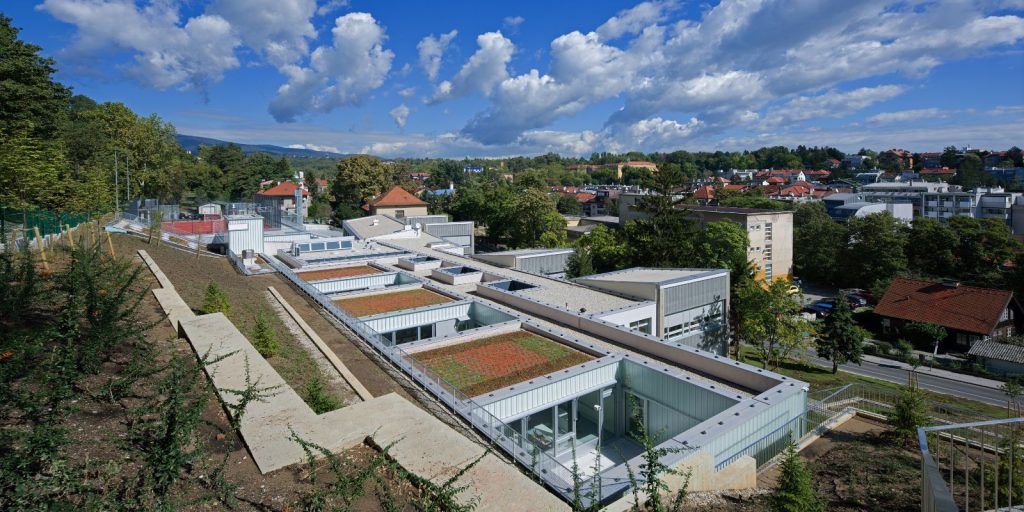
One of the key aspects of the project was earthquake-proofing the building, alongside implementing energy-efficient upgrades. The City of Zagreb provided funding for the project’s realization, although it is not part of the post-earthquake reconstruction program. The mayor explained that the project aligns with the goals of the National Recovery and Resilience Plan (NRRP) in education, leaving the possibility of retroactively drawing some funds from this program.
This project has garnered significant professional and public attention and was nominated for the “Viktor Kovačić” award by the Association of Croatian Architects, as well as the Piranesi Award. It is currently among the Croatian projects nominated for the prestigious EU Mies Van der Rohe Award for Contemporary Architecture.
IGH is proud to have participated in the realization of this project. More information about the project can be found at the following link: emajstor.hr/članak/
The construction project of the Varaždin – Krapina expressway, discussed for over two decades, is finally entering the realization phase. Institut IGH, d.d. has been selected for all services related with obtaining location permits for the Varaždin-Ivanec-Krapina expressway.
The construction of the Varaždin – Krapina expressway is part of a broader strategy to improve transportation connectivity between county centers across Croatia. The goal of this project is not only to reduce travel time but also to strengthen the regional economy. In Varaždin County, which already hosts over 50 business, commercial, and industrial zones, additional economic growth is anticipated. The year 2024 has already been marked by a surge in private capital investments, exceeding €250 million. Building a high-quality road network, such as this expressway, will further attract investors and enhance the region’s competitiveness.

At the end of February 2024, Hrvatske Ceste (Croatian Roads) signed a contract for the construction of the first stage of the expressway, covering the section from Varaždin to Cerje. This section is approximately 7.5 kilometers long, and the works are expected to be completed within three years. This segment represents the beginning of the first of six phases of the project. According to the plan, the project is divided into six routes, and the total length of the expressway has already been determined. For the final section, Hrvatske Ceste allocated an additional €600,000 for the preparation of the conceptual design, ensuring the documentation needed to finalize the entire project. The total value of this project amounts to €25.5 million, excluding VAT, making it a significant infrastructure endeavor for northern Croatia.
In addition to local benefits, this project has significant national implications. Improved transportation connectivity will facilitate the movement of people and goods, reducing transport costs and increasing business efficiency. Moreover, reduced traffic congestion will positively impact the environment, while modern infrastructure will enhance road safety.
The Varaždin – Krapina expressway project is not just an infrastructure investment but a strategic step toward modernizing Croatia. By investing in transportation projects like this one, Croatia strengthens its economic position and creates conditions for sustainable development on both local and national levels. The construction of this expressway is not merely a response to current needs but an investment in the future of Croatia.
For a more detailed insight into the construction plan of the Varaždin – Ivanec – Krapina expressway, you can watch the following video:
The new Šibenik main square with archaeological park and a garage/logistics center underneath is designed as an integrated urban, social and infrastructural field setting an open dialogue between the medieval, modern and contemporary city.
The Poljana square is designed as a continuous three-dimensional urban platform (field) without any obtrusive solid volumes, which accommodates various social events and mediates between historical and modern urban artefacts. The site programme integrates archaeological park with the social zone and infrastructural logistic center underneath. Spatial folds form places of social gathering: open tribunes and stages, bridge, canopy and fountain. Urban lines create tensions and dynamics in the platform while stone networks with infrastructural boxes enable flexible organization of the field.
The underground structure has facility designation, garage and logistics center with reinforced concrete construction and industrial floors. The underground logistics center includes a mobility management center, charging stations for electric vehicles and revitalizing old town and island supply area. The space is an integral part of the overall EU project Integrated Mobility in the City of Šibenik.

Read the full article at emajstor.hr/clanak/550/
The construction of a section of the expressway between Velenje and Slovenj Gradec, known as the Third Development Axis North, involves the development of an expressway that will significantly enhance traffic connectivity between these two cities. The Office of the Government of the Republic of Slovenia for Development and European Cohesion Policy approved co-financing for the project titled “Preparation of Documentation for the Construction of the Expressway for the 2nd Section of the Third Development Axis North from the Velenje Jug Junction to the Slovenj Gradec Jug Junction.” The project, with an investment value of €16.77 million, will receive co-financing of just under €11 million from the European Regional Development Fund.
Institut IGH, d.d. was selected to provide supervision services for the preparation of project documentation required for obtaining a building permit (DGD) and execution project documentation (PZI) for the construction of the new expressway, Section Velenje Jug – Slovenj Gradec, Segment B (Škalsko Lake), with a total length of 17.2 km.
Segment B (Škalsko Lake) represents a modification of the existing traffic configuration by bringing the Velenje-Škale road closer to Škalsko Lake. It includes plans for additional roundabouts, deviations, and an expressway with associated connections and a viaduct. Deviation 1-21 represents a new route for the existing regional road Velenje-Škale, with a length of 941.68 meters, while Deviation 1-21a represents a new route for the existing , with a length of 876.10 meters. The Škalsko Lake Viaduct is 105.00 meters long and 23.00 meters wide. It will be constructed as a prestressed concrete monolithic structure. The bridge structure will be built on two supports and four intermediate piers, founded on piles 150 cm in diameter and 22 to 25 meters long.
This expressway plays a key role in improving Slovenia's transport infrastructure, enabling better connectivity between centers of international, national, and regional importance. It will also contribute to the economic development of the Savinja-Šalek region, which is currently undergoing restructuring following the decline of coal industry activities. Additionally, the construction will enhance road safety and reduce travel time for users, facilitating daily mobility for citizens and the transport of goods.
Daruvar Spa is currently undergoing the largest reconstruction in its history. The total value of the project amounts to nearly 20 million euros, 97.22% of which will be financed through European funds from the National Recovery and Resilience Plan.

Institut IGH, d.d. has been selected as the construction supervision contractor, while the construction works will be carried out by Radnik d.d., chosen through a public tender. The planned duration of the work is 14 months, with the goal of completing all tasks within this timeframe while keeping the existing facilities operational during reconstruction.
The project includes the renovation of 77 existing accommodation units, the construction of 13 new ones, and the expansion and modernization of the pool complex. Special attention will be given to enhancing the wellness offerings, introducing innovative features such as beer baths and oak wood baths, making Daruvar Spa unique in Croatia. Massage areas, saunas, and therapeutic treatment spaces will be expanded and equipped with state-of-the-art technology to meet the highest standards of customer experience.

Additionally, a tourist-recreational center with a photovoltaic power plant will be constructed, significantly reducing energy costs, with estimated savings of 100,000 euros annually. This reconstruction symbolizes long-term plans to improve the infrastructure and services provided by Daruvar Spa, thereby raising the quality of health tourism in the region.
On September 13th 2024, the grand opening of the new tunnel tube took place, while final work on the safety systems and road signs is still being carried out.
The first Učka tunnel tube was completed in 1981 and has been important in facilitating transportation. But as traffic has been increasing, especially during the peak tourist season with more than 20,000 vehicles passing on the busiest of days, it faced challenges. The new tube will not only double the capacity of the existing tunnel but also incorporate modern safety features and improved ventilation systems. The addition of this second tube is expected to significantly reduce travel time and improve overall road safety for commuters and freight transport alike.
The new Učka tunnel has 24 transverse tunnels, every 250 m, of which 12 are for pedestrians and 12 for vehicles, which makes a total of 6.5 km of tunnels and makes it, together with connecting tunnels, the longest underground excavation in Croatia. The new tunnel tube, which is 500 meters longer than the old one, represents not only a technical achievement, but a symbol of safety. A thousand tons of explosives was used, and modern techniques that were applied for the first time in Croatia, such as conveyor belts for transporting materials and liquid explosives. The new tunnel tube is also equipped with advanced key systems to ensure its functionality and safety. As many as 74 surveillance cameras will monitor traffic and conditions in the tunnel. In total, there will be 24 cross-paths between the two tunnel tubes, and three additional large crossings for emergency interventions will be built during the renovation of the old tube.
The second tube of the Učka Tunnel, along with the Kvarner rest area, was constructed as part of the 2B1-1 Subphase of the Istrian Ypsilon's full-profile construction, with a total value of approximately 200 million euros.
During the construction, many challenges were faced – from difficult geology, a large number of pits and cracks, but also global crises such as inflation and pandemics, as well as labor shortages. One of the biggest challenges of this project was to carry out the work on time, with the existing pipe under traffic, so without stopping traffic.
The D8 Adriatic Highway section between Split and Omiš is one of the most congested roads in Croatia, with an average daily traffic of 11,000 to 15,000 vehicles. As a tourist destination, during the summer these numbers rise to an astonishing 55,000 vehicles per day, which is far exceeding the capacity of this two-lane highway. In response to this issue, Hrvatske ceste d.o.o. initiated the Omiš bypass construction project in 2007., which will ultimately bring significant traffic relief to the city center of Omiš and reduce summer and tourist season congestion.
The Omiš bypass is part of the multimodal platform project for the Split agglomeration and one of the largest infrastructure projects in the Split-Dalmatia County, with a total value of 90 million euros where Institut IGH provided services for supervision. The project included the construction of new roads with a total length of 3.7 km, access roads to the tunnel with a total length of 544 meters, the construction of the new Komorjak Sjever tunnel with a length of 600 meters, the Omiš tunnel with a length of 1470 meters, the Brzet tunnel with a length of 220 meters, and the construction of a bridge over the Cetina River with a length of 225 meters.

One of the project's unique features is the road fork located in the Komorjak Sjever tunnel, which is part of the connecting road to the state road DC70. The tunnel will accommodate two-lane traffic, with a road width of 7.10 meters and a height of 6.85 meters measured at the tunnel crown. The tunnel was constructed using the NATM technology, the most advanced tunneling method available.
Directly from the tunnel heading east, one reaches the Cetina Bridge. The bridge is a continuous beam span of 30.00+152.00+30.00 meters, based at the ends of the tunnels Komorjak Sjever and Omiš, with the largest span of 152 meters between two supports. The slender structure of the bridge, a closed steel box of variable height (2.50 m - 6.50 m), fits seamlessly into the environment without obstructing the view of the Cetina canyon. For the construction of the bridge, 1280 tons of steel was used. The assembly and erection of the bridge halves were conducted in the Komorjak Sjever and Omiš tunnels, with the final joining completed 70 meters above the Cetina River using special hanging scaffolds.

From the Cetina bridge, one immediately enters the next tunnel called Omiš, which is 1470 meters long. The tunnel begins at about 70 meters in height, on a steep cliff above the Cetina River, and runs east and northeast of the old town center of Omiš through the slopes of the Omiš Dinara massif. The tunnel is initially straight, then in a right curve, followed by another straight section and a right curve, and finally a left curve. The total road width in the tunnel is 7.1 meters, with a maximum clear width of 9.9 meters and a clear height in the center of the road of 6.85 meters. The road structure is 55 cm high, consisting of a wearing course (3.5 cm), a binding layer (5.5 cm), a bituminous base layer (7 cm), and a mechanically compacted layer (40 cm). Additionally, two evacuation tunnels were constructed within the existing Omiš tunnel, measuring 339 and 205 meters in length, respectively.


To complete the bypass and the Split – Omiš highway one smaller tunnel was needed. Tunnel Brzet, 220 meters long, which connects the expressway to the Adriatic Highway DC8. The tunnel is initially in a right curve, ending in a left curve, with the grade beginning to decline and continuing in a convex curve to the end of the tunnel. The road width, maximum clear width of the tunnel tube, and clear height in the center of the road are the same as in the Omiš tunnel, as are the road structure, drainage, and waterproofing. The portals are formed with a frontal wall that laterally connects to the embankment wall, and as it is a smaller tunnel, no longitudinal ventilation is planned.


We congratulate the investor, Hrvatske ceste d.o.o. on another successful project, as well as the contractors Viadukt d.d., Strabag d.o.o. and our amazing team of experts in the field of supervision. It is an exceptional honor for us to provide our services on yet another significant infrastructure project of great importance for the Republic of Croatia. We look forward to our continued partnership and collaboration.

